
INTERVIEW

Alice Gee | 16/10/2026
For Matt Hansen, the last four years have been about healing, learning to sit with uncomfortable truths, and finding the courage to turn pain into something meaningful. Orchid isn’t just a personal, vulnerable album; it’s been a door into some of his most difficult experiences, transforming private moments into songs in the hope of offering connection, comfort, and ultimately hope. Speaking from Warsaw on his latest European leg, Hansen reflects on the moments and processes that shaped Orchid, the freedom he’s felt in independence and the importance of giving himself permission to feel, embrace and move forward. Honest about the challenges that come with seeking therapy and the weight of his own expectations, it’s a candid conversation about learning to confront rather than suppress, and the hope of encouraging others to do the same. Yet for all his vulnerability, Orchid is not simply an album about looking back; instead, it marks a closing chapter where his sight is fully forward-facing, without the worry that it will erase his past and its very important experiences. Hansen is ready to widen the lens while keeping those all-important Matt Hansen big vocals, while retaining the emotional honesty that has become his signature. It’s a period that stands as a testament to the possibility of finding light in the darkest moments, and an ode to the quiet, powerful realisation that sometimes, making it through brings its own kind of euphoria.
Alice: Hi Matt!
Matt: Hey, what's up? Good to see you.
A: You too. How are you doing?
M: Good! How about you?
A: How's tour going?
M: It’s been great. Super fun. It's getting to the end, which is kind of sad, but it's been amazing.
A: Whereabouts are you at the moment?
M: Currently in Warsaw. Never been here before, but it's really cool.
A: I hope you’ve had a small window to go and explore!
M: Technically, today is my only day off here, but I have interviews to do today, so I don't have tons of time. But I had a couple of hours to roam.
A: I wanted to touch upon Orchid. It's obviously such a personal project for you with so many intimate, vulnerable moments. When did you realise those moments were becoming more of an album than just a way of processing your thoughts?
M: It really hit me about a year and a half ago. I think there was a moment where I had just written Orchid, and the second I wrote that song, I was like, "That's the name of my album”. After I had written that song, I thought, this is nearing the end of this healing arc that I've been walking down for the last four years. It felt like I was nearing the end of that chapter of my life. It felt like a good time to put a cap on that story, and it is coming full circle. I wanted to kind of move on from that piece of my life because I feel like I had kind of been beating a dead horse and singing songs about the same things over and over again. I just felt more healed. It felt like a natural stopping point in my music and to then have people join me at another part in my life.
A: It feels like a really poignant moment for you. There’s often moments where you feel like you’ve been able to finally say something you’ve been looking for a really long time. I'm imagining when you were writing this, that maybe there were moments where it all just clicked, and it felt like the right time to say things that maybe you hadn't been able to.
M: One hundred per cent. I got to a point where I felt like I totally said exactly what I wanted to say about the situation, which was so cool because I never had imagined that I would have those kinds of realisations from that kind of trauma or that kind of pain. When you get to the other side, you think, of course, you have those realisations, but when you're in it, you never think you can get to that point or write that song.
A: There will be so many people that will resonate with it, and hopefully, it might help them find the confidence, whether it's speaking about their own situation or at least feeling seen and heard. How did you articulate those feelings and find that groove with it? Because it's extremely difficult, especially for men, to open up around those stigmas attached.
M: I mean, there's a lot of, like, interesting things that come with that. The first thing is I had never gone to therapy before all of this stuff had happened, and I definitely looked down on it as something I didn’t need, thinking I'd be okay. Like I can muscle my way through it. A classic man thing to do, you know. There was a point that I reached where everything just continually got worse. Every day, I was like, "I'm not getting any better. Everything's getting worse.” All of those little triggers were hitting me every day. Like I’d be at a bar with my friends and I was miserable. Like that's not right, you know. I think I had a massive wake-up moment of either you go through this, or you just tiptoe around it for the rest of your life and become this scared, emotionally unavailable person, and I just didn't want to do that. It sounded miserable to me, and I thought anything is better than how I am right now. I'm very happy that I chose to go through it.
I was going to therapy two or three days a week for like six months, and it was intense. There were many days where I was like, I don't like this. Like I'm just reliving everything that I went through. But I think there are so many amazing things that came from it, and I feel like I'm just more aware as a human being after I went through it. I had actually grappled with it, and actually tackled things that I went through. I finally understood why I stayed, why I left, why I did this, why I didn't speak up for myself in this situation, and all of those different things. I think people tend to hold so much inside and wait for a random day to deal with it. They often feel they will deal with that kind of stuff later, but there's no better time to deal with those things than now, even if it seems like the most inopportune time. For me, my career was crushing, and I was like, "I just can't do this right now, so I needed to take a step back”. To be honest, I don't think I would have the career I have now if I had done that. So would highly encourage any men who have been through anything to go to therapy; it does help a lot, and you are not less of a man for going.
Jacket, Blaur. Cardigan, Celine. Jeans, Chet Rock. Belt, Elliot Rhodes. Necklace, LAG WORLD. Watch, Hublot. Rings, LAG WORLD & Thomas Sabo. Sunglasses, Akila.


Denim jacket & trousers, Feng Chen Wang. Denim top, Spiorre. Shoes, Grenson. Belt, Elliot Rhodes. Sunglasses, Lunetterie GÉNÉRALE. Watch, Hublot. Necklace, A sinner in pearls.
A: I think it's amazing you threw yourself into it, as, to be honest, there’s never a good time.
M: The biggest issue was I wasn't living normally anyway. I was like, I really need to talk about everything that I went through, and it helped a lot just to tell someone everything because I hadn't told anybody anything. I just needed to get it out. I eventually went down to one day a week, but at the beginning, I needed to get it off my chest, like. It worked perfectly for me. So, yeah, that was amazing.
A: It’s always so lovely to hear when someone has a warm experience with therapy. When you revisit experiences like that, have you found the music has brought some sense of closure or a door opening for you to take in moving forward?
M: I mean, it's probably been the best kind of closure I could ask for because I'm basically writing down my deepest secrets and then, like, letting go of them out into the world. It's a very freeing feeling. It almost feels like you are taking all of these painful moments and letting them become lessons for the world. It feels so good every time that I write one of those songs and every time that I get to play it on stage too. I know that some people don't particularly like to revisit their trauma; it doesn’t feel very empowering for them, but for me, just as someone who likes to feel like I'm making progress, like stepping past it, I really do enjoy playing the songs every night and kind of revisiting it and knowing that I'm not retraumatising myself. It feels very powerful to play these songs and remember that feeling - it's not me right now. It's almost very euphoric to me. I don't know why. It's probably one of the reasons why people listen to sad music, and they feel happy afterwards. It feels similar to me. It's been a very cool experience, especially like playing them live. I really get to go through all of those emotions once again. There have been moments where it gets to be a lot. But I think that at the end of the day, dealing with the knowledge that this will always be a part of my life, and I can't just erase it from my brain, is a comfort in knowing that this is a part of my story. It’s fine, and I will continue to remember it because it makes me who I am. I think that’s important for me, as a step in moving forward.
A: Totally, and it's so interesting that line ‘moving forward’ because I was going to bring it up. I'm really big on the phrase ‘moving forward’. I'm not as good with the phrase ‘moving on’.
M: It’s like it means that you're leaving all of it behind.
A: Exactly that! Something you said is interesting because when it comes to writing about some of the most vulnerable moments of your life, do you find there are parts you want to hold that space for personally? It’s that throw up between protecting parts of yourself but also pouring your soul out.
M: I mean, I've always been cautious about being super specific about what I went through, just because I don't think it's my specific situation that is relatable, point for point, bullet point for bullet point. But it’s the feelings, the overall situation and the outcome that are extremely relatable. I want to have that kind of comfort that there are only some really close people that actually really know what happened, and I think that feels a little bit safer that way. I think also, just in terms of really traumatic events and naming them by their names, I want people to kind of put their story into these songs because that's what's most important to me. Knowing people are able to put their own version of this song is very moving. I get to meet a lot of people at meet and greets and hear different ways that they interpret these songs, and I love that. That's one of my favourite things. It also makes me happy because it means that I'm doing my job correctly. I've always liked to keep my own personal life pretty private, and that's kept my mental health good over the last five years. People can infer, and they can guess, and it's pretty clear that there were some bad things that happened, but I think the specifics are up to me and my journal, friends and stuff. That's who gets to hold those kinds of memories, and I trust those people. I think there always has to be that kind of boundary for me. I applaud any artist who really lays their whole story out on the line. I think it's so brave to do that, but for my own sanity, I don't think I could do it.
A: It’s so lovely to hear you know and protect that space. When it comes to your music, you're independent. What do you love most about that independence and the autonomy that comes with that?
Shirt, Spiorre. Tie, LAG WORLD. Blazer, Yuhan Ao. Trousers, Topman. Shoes, G.H Bass. Sunglasses, Akila.

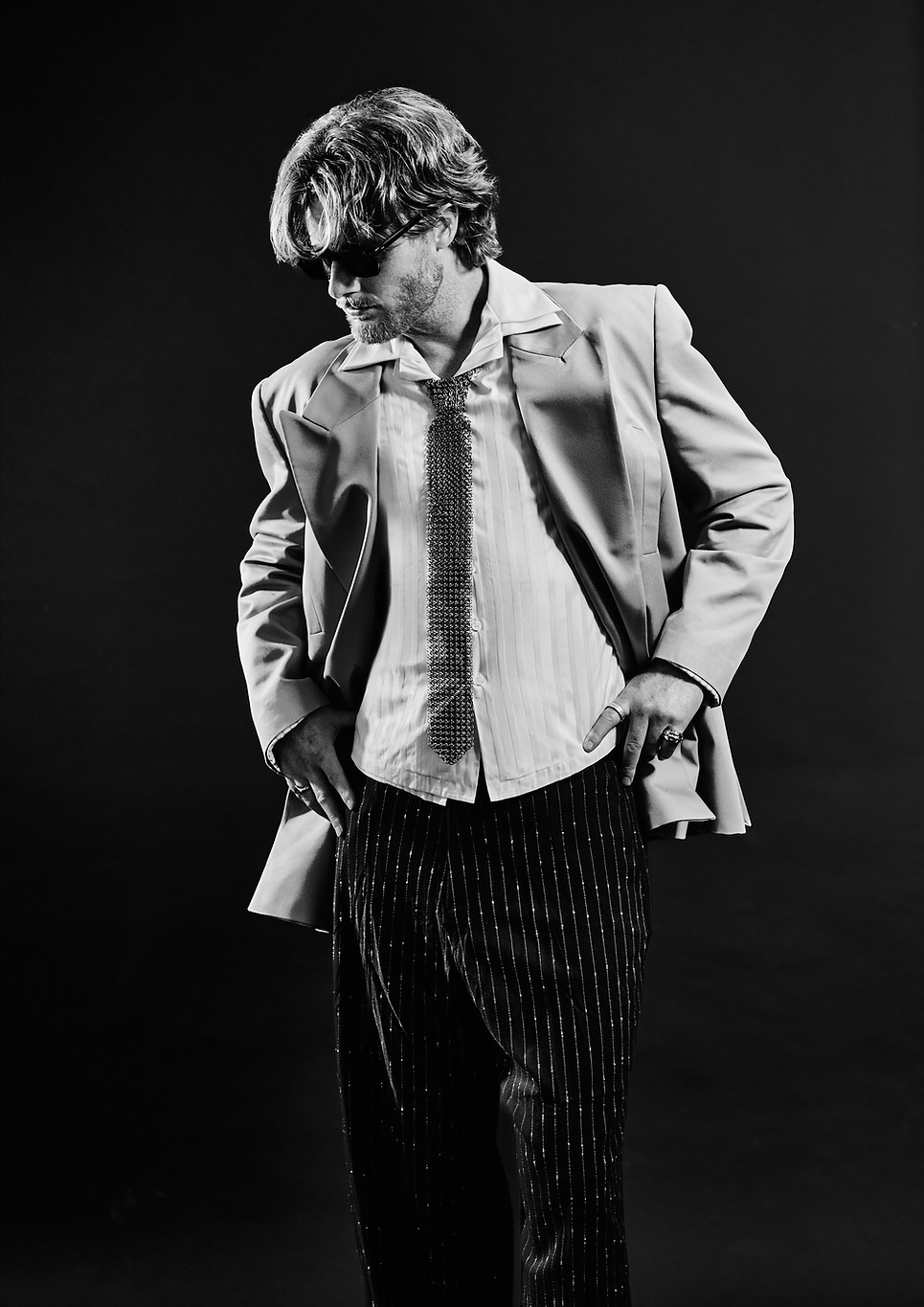


M: It's exactly what you said. It's the freedom that I have to hire whoever I want- anybody who I deem worthy to be on my team; I can just bring them on. There's no other person who decides that. Not only has my team grown exponentially over the last couple of years, but it's almost like I'm collecting friends through all of these people. I just love these people that I work with every day. I genuinely love the fact that I can control that. Obviously, there are a lot of hiccups that happen when you don't have infrastructure, and it's difficult as an independent artist when you're trying to figure out specific financial stuff that normally labels figure out, and you kind of have to put on your CEO cap for a second, which, as an artist, is not a normal feeling; it's very odd, but I've grown to love it. I've grown to figure out how to do it. And luckily, I've had great people around me to teach me how the business works. I've learned so much from people around me about how the business works. If you didn't know, I interned at a record label, APG, which is under Atlantic Records, for two years when I was in college, and so I really understood how the label system works, the publishing side, and the master side, how songwriter deals work, and how the producer deals work. So that's been super helpful over the last couple of years of just figuring out how to do this ethically and profitably because that's the hardest part. When you're independent, you kind of have to treat every song like it's an asset and make sure that it makes money, or otherwise you’re screwed, because you're the one taking all the risk. There's nobody else taking any risk. But it's been-I mean-the greatest joy of my life. I absolutely love it, and I'm so proud of what I've built because all of it has been with my team and my friends, all of us just building this together, and it's succeeded.
A: It's amazing, as often people come into the industry without experience, and it can be hugely overwhelming. As you move towards new music, where do you find that you're going?
M: I have already written probably six songs that I am positive will be on the next album, and I think I'm just exploring a lot more, a lot different topics. Obviously, I'm not going fully away from heartbreak songs because I will always have stuff to share about that. We love them, but I think I've always wanted to talk more about not only mental health, but just life in general, and you know, the world. I want to talk about friendships and family. There are so many other topics that I'm very passionate about, and that I've been through as well. I've been through difficult situations, but I've also been through great situations. I've witnessed wild things. I think the next album brings a larger lens. I've really, over the last couple of years, experienced so much just in terms of travelling the world and meeting new people. I'm really stoked for still the same Matt Hansen big vocals – they’re not going anywhere but exploring some different topics.
A: I think it's so interesting how we always assume a lot of songs are about relationships, romantically, but some of the greatest love songs are just about platonic friendship. When you look back on this chapter of your life, what would you most like the next album to feel like, and what will it stand for for you?
M: I mean the biggest thing is my journey and turning pain into hope. It's been four years of a very odd, up-and-down, roller-coaster kind of healing path. "Orchid" being the last track, it's inherently a very melancholy song. But I think the point is that these kinds of feelings, you know, they never fully go away, and I think that there's a lot of power in that. There's a lot of power in knowing this is a part of my story, and I'm going to continue to remember that. I'm grateful that I made it out the other side, and that I'm happy now. There's that kind of euphoria that comes from knowing that you made it. After so many years of not really knowing what was next, and whether I could forget it or fully move forward, I am moving forward. That's probably the best thing.
Creative Alice S Gee
Photography Jacquetta @jaquetta.studio
Styling Dianah Gwendu @dianahgwendu
Grooming Xabier Celaya @xabiercelaya
Photography Assistant Taja Jade @t_jxde
Styling Assistant Jeniya Gwendu @mamagwendu
Styling Assistant Matthew Dominic @berryclothingco
Words Alice Gee @alicesgee
Suit, Agro Studios. Vest, Spiorre. Shoes, Grenson. Ring, LAG WORLD.


